

What Really Happens During a Yacht Survey?

Most buyers imagine a yacht survey involves somebody tapping the hull with a hammer and writing a report.
The reality is very different. Recently I carried out a full pre-purchase survey on a Beneteau Oceanis 48 in Preveza. What followed was a long day of inspections, testing, sailing and investigation that revealed far more than could ever be discovered during a simple viewing.
The day began with a detailed structural inspection ashore.

Every accessible part of the hull was examined. Moisture meter readings were taken across the underwater sections, percussion sounding was carried out on suspect areas, and the keel attachment, rudder bearings, stern gear and skin fittings were all closely inspected.
From there the inspection moved onto the deck, rigging and safety equipment.
To the casual observer everything appeared in excellent condition. The yacht had clearly been cared for and presented well. However, even on well-maintained vessels, surveys frequently reveal issues hidden beneath lockers, behind panels and inside machinery spaces.
Once the shore inspection was completed, it was time for the sea trial.
For several hours the yacht was sailed and motored in the Abracian Gulf while every major system was tested. Engines were run under load, steering systems checked, navigation equipment operated, the autopilot tested, generators loaded and electrical systems examined during real-world operation.


Sea trials often reveal problems that are impossible to identify ashore. Vibrations, unusual noises, steering issues, overheating engines, charging faults and electronic problems frequently only appear when a yacht is operating at sea. On this occasion the vessel performed extremely well.
The yacht sailed beautifully, engine temperatures remained stable, steering response was positive and the onboard systems generally operated as expected. A handful of maintenance items were identified, as would be expected on any used yacht, but no major structural concerns were discovered.
By the end of the day the buyer had something far more valuable than a sales brochure or owner's description.
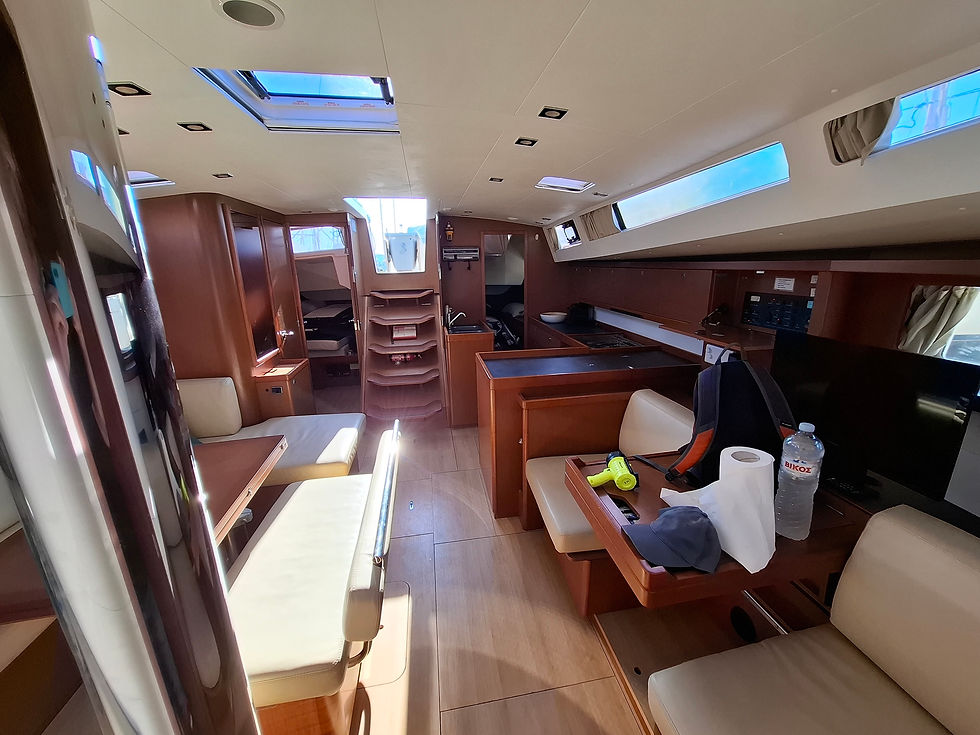
They had an independent professional assessment of the yacht's actual condition.
Buying a yacht is often one of the largest purchases many people will ever make. The difference between a good boat and a good-looking boat can sometimes amount to tens of thousands of euros.
That is why a proper survey matters. The objective is not to find reasons not to buy a boat.
The objective is to ensure you know exactly what you are buying. Because once the yacht is yours, every problem becomes yours too.
Steven Truss MIIMS Marine Surveyor


Comments